
Asset Optimization (Circular Economy 2/3)
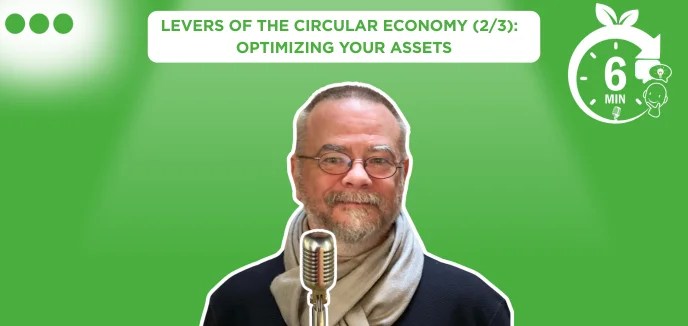
Optimizing Your Assets: The Hidden True Lever of the Circular Economy (2/3)
The Circular Economy, Optimizing Your Assets – “6 Min. to Understand” with Pierre Léonard. Midoricast: Podcast #228
The circular economy is not limited to recycling; it relies on a series of complementary levers, and the one explored here by Pierre Léonard deserves our full attention: asset optimization.
Companies, institutions, independents… we all possess often underutilized resources: machines, spaces, vehicle fleets, but also software, servers, or databases.
In this episode, Pierre clearly demonstrates how extending the lifespan of our equipment and intensifying their use can reduce costs, strengthen competitiveness, and contribute to a genuine sustainability approach. Through concrete examples, from the shared studio pooling by The Podcast Factory Org to asset rentals between companies, he invites us to rethink our practices and act more intelligently, more collectively, and more profitably.
Optimizing your assets means doing more with less while reducing your carbon footprint. A win-win approach, both ecological and economic, which perfectly illustrates the circular logic: before buying new, it is better to learn to make better use of what we already have.
This episode is part of the “Circular Economy” triptych:
- Saving resources
- Optimizing assets (current episode)
- Reducing waste (upcoming)
Listen to this podcast and subscribe, thank you!
To subscribe, choose your favorite app via the “See All” button in the list available on our Linktree.
For people who are deaf, hard of hearing, or experiencing hearing difficulties, we provide a full transcript at the end of the article.
Make a donation to support our work: Triodos — IBAN : BE73 5230 8097 4160 — BIC : TRIOBEBB
Useful links for this episode:
- Pierre Léonard’s Linktree
- The Fresque of the circular economy
- Website of The Podcast Factory Org asbl-vzw
- Join the Kaya coalition
Links to support our association:
- Our affiliate link to O2Switch for top web hosting!
- Review our association The Podcast Factory Org asbl-vzw and its missions via our Google profile
Our podcasts are accessible to everyone!
In addition to voicemail, each episode is segmented and accompanied by a full transcript, allowing deaf and hard-of-hearing people to access it. With a Google Translate plugin under Chrome, the episode becomes available in all languages! We also offer a video format and subtitle transcriptions.
Why this section?
We support companies implementing real and measurable ESG (Environmental, Social, Governance) practices. Pierre trains and supports them through this transition. Our approaches are different but complementary: we encourage, he guides.
This choice also presents a real challenge: where to draw the line?
Some companies mentioned in this section are not aligned with our current criteria, and we would refuse collaboration with them until they make concrete changes. But this is precisely where Pierre intervenes: his role is to initiate this transformation.
This podcast is not meant to judge, but to inspire. The goal? Encourage rather than discourage, support rather than exclude.
Let’s commit together to a circular, sustainable, and inclusive economy. Listen, reflect, act… in 6 minutes.
Listen to this podcast “Asset Optimization” on our YouTube channel (subscribe: thank you!):
French: The full transcript of this podcast is available as video subtitles in five languages: French, Dutch, German, English, and Spanish.
Dutch: De volledige transcriptie van deze podcast is beschikbaar als ondertiteling van de video in vijf talen: Frans, Nederlands, Duits, Engels en Spaans.
German: Die vollständige Transkription dieses Podcasts ist als Untertitel des Videos in fünf Sprachen verfügbar: Französisch, Niederländisch, Deutsch, Englisch und Spanisch.
English: The full transcript of this podcast is available as video subtitles in five languages: French, Dutch, German, English, and Spanish.
Spanish: La transcripción completa de este pódcast está disponible como subtítulos del vídeo en cinco idiomas: français, neerlandais, allemand, anglais y español.
Podcast Segmentation “Asset Optimization”:
- [00:00:02] Introduction and context of the Midoricast podcast
- [00:00:11] Topic: asset optimization
- [00:00:25] Reminder of the triptych – phase 1: before
- [00:00:39] Phase 2: during
- [00:00:50] Examples of tangible and intangible asset optimization
- [00:01:17] Maximizing use and lifespan
- [00:01:38] Underutilization of resources
- [00:02:07] Example with The Podcast Factory Org
- [00:02:46] The example of the unused car
- [00:03:03] Reduction of investment costs
- [00:03:25] Productivity improved by sharing
- [00:03:35] A consulting firm shares its meeting spaces
- [00:04:16] Organizational intelligence costs less than investing
- [00:04:45] Case study: logistics company
- [00:05:01] How to do it?
- [00:05:27] Explore solutions
- [00:06:01] Conclusion
- [00:06:23] Reminder: Green IT and responsible hosting
- [00:06:33] Announcement of the next episode: waste reduction
- [00:06:50] Call to action and closing
Podcast transcription “Asset Optimization”:
Jingle Intro: [00:00:00] Your listening to the Podcast Factory Org.
Michel: [00:00:02] Welcome to another episode of “Midoricast”, your podcast on positive environmental initiatives. 6 Minutes to Understand” with Pierre Léonard. Ladies and gentlemen, I’d like to give him the floor. Thank you very much.
Pierre Léonard: [00:00:11] Hello Michel, Hello everyone! In this episode, I’d like to explore the second essential lever of the circular economy. And what is this second lever? It’s about optimizing your assets.
Michel: [00:00:25] This is a three-part series in the “6 Minutes to Understand” series, so let’s set the scene.
Pierre Léonard: [00:00:29] Exactly. And indeed, in the first episode devoted to the circular economy, we saw why it’s important to save resources. And that’s something that comes before use.
Pierre Léonard: [00:00:39] Today, we’re going to move on to phase two, during the utilization phase, and so our assets, the things we’ve bought or acquired, what can we do to optimize their use?
Pierre Léonard: [00:00:50] So basically, there are two ways to do it. This is achieved either by extending their lifespan, or by intensifying their use, by using them more intensively. Let’s take a closer look at how it works? And we’re talking about all your assets. We’re talking about your machines, your equipment, your storage space, your offices, but also your intangible assets such as software and databases.
Pierre Léonard: [00:01:17] The idea is to maximize their use and lifespan, rather than buying more and more often. You can imagine your business as an orchestra. Instead of buying new instruments for every concert, you’ll learn to play the ones you have more harmoniously and for longer. Asset optimization is exactly that.
Pierre Léonard: [00:01:38] So, as we saw in the previous episode, resources are becoming scarcer or more expensive, with a consequent increase in acquisition costs, so optimizing what you already have is obviously very important. However, whether we’re talking about industrial equipment or office space, we’re often in a situation where they’re not used at all to their full capacity, or in the case of offices, for example, they’re only occupied 40% of the time on average.
Pierre Léonard: [00:02:07] And that’s where I’m particularly happy to be, because in this studio we have a superb example of optimization, because Michel, you confided in me that when you’re not using your equipment, you’re giving access to other people. And Michel, I congratulate you on your circular economy by optimizing your resources.
Michel: [00:02:28] It’s conscious, and that’s the point. It’s an exchange of processes between transforma bxl and us: we don’t have to pay for the studio, and in exchange the equipment is shared. In other words, I train and lend all my equipment to anyone who wants to record at transforma bxl.
Pierre Léonard: [00:02:40] In English we’d say “You walk the talk”, i.e. you put your money where your mouth is. So once again, congratulations!
Pierre Léonard: [00:02:46] Another example, which we’re all familiar with, is our car. It stays in the garage 95% of the time, and it’s a waste. Asset optimization is precisely the answer to this chronic inefficiency, which undermines company competitiveness.
Pierre Léonard: [00:03:03] As you can see, the benefits of optimization are numerous and easy to measure. The first piece of good news is that you reduce your investment costs. Instead of buying new, you keep the things you have longer. Your accountants may start by grumbling a little about the amortization period, but you’ll have no trouble convincing them of the benefits.
Pierre Léonard: [00:03:25] Secondly, you improve your productivity: a printer used for five departments instead of just one, means a five-fold increase in productivity without any additional investment.
Pierre Léonard: [00:03:35] In the service sector, it’s just as relevant: take the example of a consulting firm which, for a fee of course, shares its meeting space with other companies on evenings and weekends. The result is a halving of property costs and a higher occupancy rate.
Michel: [00:03:52] It could even be profitable, right? Imagine a company, which I’m not going to name in the big telecoms sectors well known in Brussels, which decided that all its meeting rooms after hours, when they don’t need them, or even within hours, in the middle of the day but when they’re unoccupied, could be rented out to external people at hyper-reduced prices, which would also make them some money. Not only are these shared resources, but they’re also a gain in terms of additional resources.
Pierre Léonard: [00:04:14] Exactly.
Michel: [00:04:15] They have a janitor and a receptionist anyway.
Pierre Léonard: [00:04:16] Yes, and you can ask for financial compensation, or a different kind of compensation, that’s up to each individual. And best of all, optimizing assets often requires more intelligence and communication than financial resources. Investments are generally modest, perhaps a few sensors to monitor your equipment, asset management software or simply a reorganization of your space. And the returns on investment are impressive.
Pierre Léonard: [00:04:45] A logistics company I worked with increased its warehouse utilization rate by 15%, simply by reorganizing its flows, and its current annual savings are €20,000 for an optimization cost of €500,0, not a bad return.
Pierre Léonard: [00:05:01] But perhaps you’d also like to put this approach into practice, so how do you go about it? Start by reviewing your assets. As usual, we start by analyzing what we have. Ask yourself the right questions: what equipment am I underusing? What spaces remain unoccupied? Especially when it comes to storage – and I’d like to stress this point – we don’t realize how much storage space remains unused. And what paid software do I use only occasionally?
Pierre Léonard: [00:05:27] Then, explore solutions, systematize predictive maintenance to extend the life of your machines, pool your assets with other companies, I’m thinking of the fleet and logistics. Or opt for short-term rental rather than purchase. A construction company I know rents out these cranes to its competitors, when it’s not using them, resulting in 30% additional income on these assets. This last specific aspect of optimization is particularly interesting, and I’ll devote a future episode to it.
Pierre Léonard: [00:06:01] In conclusion. Optimizing your assets means turning your fixed costs into competitive advantages. It means doing more with less, while reducing your environmental impact since, by definition, an object that lasts longer needs to be replaced less often. A win-win approach that reconciles ecological performance and economic responsibility.
Michel: [00:06:23] I think this is really an episode where people need to be reminded once again to “GreenIt”, and choose green servers and hosting, with as little carbon impact as possible.
Pierre Léonard: [00:06:33] I think this is very, very important indeed. In fact, we’ll be devoting a whole episode to it. Thank you for listening to this episode of “6 Minutes to Understand”. See you soon to discover the third lever of the circular economy: waste reduction.
Michel: [00:06:50] Waste reduction, we note. See you soon and then leave a voice message for Pierre Léonard without hesitation, with a suggestion, a remark, a gratitude and why not a question? We’ll be happy to answer (Pierre Léonard: With pleasure), see you soon!
Michel: [00:07:01] This podcast project is an initiative created and proposed by the ASBL “The Podcast Factory Org”, with the sponsorship of “transforma bxl – Innovation Playground”, a coworking space in Evere. Since January 2025, and for five years, we have also been sponsored by “Plugin Company”, our preferred charging station and card operator. The Podcast Factory Org” is proud to be a member of “KAYA – Coalition des Écopreneur” and “Écopreneures”, and to collaborate with the “Love Health Center”. You can find all the episodes of all our podcasts on the “What’s Your Story point be” website. Don’t forget to subscribe to our YouTube channel @thepodcastfactoryorg, where we offer the podcast in video format with subtitles in several languages.
All our Midoricast podcasts

Podcast: Play in new window | Download
#PodiBUZ, the editorial brand of The Podcast Factory Org ASBL-VZW.


