
Sustainable development and the great acceleration
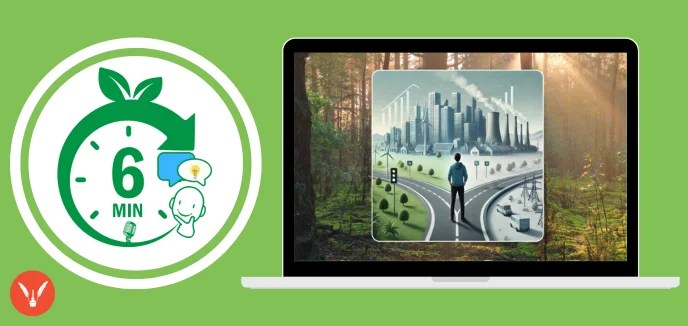
Sustainable Development and the Great Acceleration: “6 Min. to Understand” with Pierre Léonard. Midoricast: Podcast #203
Sustainable development and the great acceleration: at the heart of the challenges of our time. Our world has shifted in a historic moment. Two inventions have propelled our society into an era of unprecedented prosperity… but also into a spiral of resource depletion.
- How did we get here?
- Are we at a turning point?
In this first episode of “Six minutes to understand”, Pierre Léonard, facilitator in circular economy, tells us the fascinating – and alarming – story of humanity facing its own environmental impact. A vital awareness for anyone concerned about the future. Listen now and join the discussion! We invite you to leave a voicemail on our voicemail.
- What are your concerns about sustainable development?
- What topics would you like to see addressed in upcoming episodes? (6 episodes are already scheduled, but your opinion matters)
Join us in this crucial reflection!
We provide an English transcript of the teaser for this podcast in this article. However, if you are learning French (podcasts are a great way to train your brain to get used to a language, making it easier to learn or practice) or if you understand it as well, feel free to listen this episode here and subscribe to the podcast via Podcastics (If you follow this link, it is only valid for 7 days.), our podcast host. To subscribe, select your favorite app via the “See All” button in the list on our Linktree.
Useful links for this episode:
- The Linktree of Pierre Léonard
- The Fresco of the circular economy
- Website of The Podcast Factory Org asbl-vzw
- Join the Kaya coalition
Links to support our association:
- Our Podcastics affiliate link (Note: valid for 7 days after opening the link)
- Review our association The Podcast Factory Org asbl-vzw via our Google listing
- Make a donation to support our missions : Triodos — IBAN : BE73 5230 8097 4160 — BIC : TRIOBEBB
Our podcasts are accessible to all!
In addition to the voicemail, each episode is segmented and accompanied by a full transcript, allowing deaf and hard-of-hearing individuals to access it. And with a Google Translate plugin under Chrome, the episode becomes available in all languages! We also offer a video format.
Why this section?
We support companies that apply real and measurable ESG (Environmental, Social, Governance) approaches. Pierre, on the other hand, trains and supports them through this transition. Our approaches are different, but complementary: we encourage, he guides.
This choice also presents a real challenge: where do we draw the line?
Some companies mentioned in this section do not align with our current criteria, and we would refuse any collaboration with them unless they initiate a concrete change. But this is exactly where Pierre comes in: his role is to initiate this transformation.
This podcast does not aim to judge, but to inspire. The goal? To encourage rather than discourage, to guide rather than exclude.
Let’s commit together to a circular, sustainable, and inclusive economy. Listen, reflect, act… in 6 minutes.
The transcript of the podcast “Sustainable Development and the Great Acceleration”:
Michel Godart: [00:00:00] This podcast project is an initiative created and proposed by “the Podcast Factory org” npo, with the sponsorship of “transforma bxl – Innovation Playground”, and you can find all the episodes on the “What’s your Story.be website”.
Michel Godart: [00:00:18] Welcome to another episode of Midoricast. Midori means green in Japanese. Cast for Broadcast. It’s a podcast about positive initiatives in favour of the environment. Today we’re in a new six minutes to understand section, hosted and directed by Pierre Léonard.
Pierre Léonard: [00:00:33] Thank you very much Michel. I too would like to welcome you to six minutes to understand, the section that answers all the questions decision-makers have about sustainable development. I’m Pierre Léonard, circular economy facilitator, and for this first episode of your new favourite podcast, I’d like to tell you a little story. No, actually, it’s a big story. It’s an extraordinary story that goes back to the dawn of time, spanning hundreds of thousands of years. And it’s the story, obviously, as you may have guessed, of our species, homo sapiens, and its presence on the only planet it has ever been given to inhabit. This story began around 200,000 years ago. We don’t agree on the exact day and time, but the date is more or less unanimously accepted. And so, for almost the whole of that period, we lived in more or less good harmony with our environment. OK, we did contribute to the extinction of mammoths and sabre-toothed tigers, but as the saying goes, that’s a detail. We used wind and water power to run our mills. We had oxen, horses and even elephants to pull heavy loads. We mined half a dozen metals, copper, gold, iron and also a little coal, but all in the traditional way. And there weren’t very many of us. There were about 250 million of us around the year 1000, double that around 1500 and about 1 billion around 1800. And that’s precisely when everything changed, in literally a few years, with two inventions that propelled us into a completely different era.
Pierre Léonard: [00:01:59] The first was the invention of the steam engine. Steam was nothing new in 1800, we’d known about it since Antiquity, but no one had ever had the idea of using it to multiply our strength. And that’s exactly what we’re started doing around 1769, when James Watt created the first modern steam engine. And what was this steam engine going to do? It catalysed the industrial revolution and kick-started our fossil fuel craze.
Pierre Léonard: [00:02:26] And then, almost simultaneously, at least on the scale of our species, we invented – or rather mastered – electricity. Because once again, even the ancient Greeks knew about electricity, but they had never taken it any further.
Pierre Léonard: [00:02:38] So the real revolution came in the 19th century, when we invented the dynamo and the bulb. And so the combination of these two inventions, the steam engine and electricity, it’s going to propel us, us brave Sapiens, to the status of Super-Heroes endowed with Super-powers. Because overnight, still in historical terms, we find ourselves with the possibility of replacing our blacksmith’s hammer with industrial rolling mills, of replacing our horses with railways and therefore of multiplying almost infinitely the power we had until then.
Pierre Léonard: [00:03:12] And we entered an era of prosperity that our species had never known. Mass production radically reduced the price of everything. The mechanisation of transport opened up new horizons, resulting in a truly unprecedented increase in our standard of living and life expectancy, which continues to this day.
Pierre Léonard: [00:03:30] The only problem is that this leap forward has been coupled with consequences that are far from ideal. Because, with such fabulous resources at our disposal and still Stone Age brains, we began to draw ever faster, ever deeper and ever more greedily on our natural resources, forgetting in the process a fundamental truth: on a finite planet, these natural resources are also finite.
Pierre Léonard: [00:03:58] And this phenomenon became even more obvious after the Second World War with what was called the “great acceleration”. Basically, from the 1950s onwards, we began to consume more of everything: more electrical appliances, more cars, more meat, more travel, with exponential growth for a whole series of economic indicators, but also an explosive increase in environmental impacts, including the notorious greenhouse gas emissions caused by our addiction to fossil fuels.
Pierre Léonard: [00:04:26] And that’s how Sapiens happily entered the Anthropocene era by exhausting its resources and smashing planetary limits one after the other.
Pierre Léonard: [00:04:36] We’ve seen this over the last year or so, but it’s happening more and more. We really are at a crossroads. We can either continue on this truly self-destructive path, or we can become the guardians of our planet. But the choice is pressing, and it is precisely out of this urgency that the concept of sustainable development was born, i.e. a form of development that meets our present needs without compromising the ability of future generations to meet their own needs.
Pierre Léonard: [00:05:04] And this is exactly the theme that will run through the various episodes of this section, during which we will try to answer the questions that you, the decision-makers, are asking yourselves, and perhaps provide you with some answers along the way. Because in this adventure that is our future, you too are heroes.
Pierre Léonard: [00:05:23] In the next few episodes, we’ll start exploring the principles of sustainable development and, above all, the benefits it can bring to organisations. Thank you for being with me for these six minutes to understand, and stay tuned.
Michel Godart: [00:05:34] So of course, you still have the link for the voice mail. Leave a message for Pierre Léonard. Thank you Pierre.
Pierre Léonard: [00:05:40] See you soon Michel.
Michel Godart: [00:05:46] This podcast project is an initiative created and proposed by “the Podcast Factory org” npo, with the sponsorship of “transforma bxl – Innovation Playground”, and you can find all the episodes on the “What’s your Story.be website”.
All our Midoricast Podcasts

Podcast: Play in new window | Download
#PodiBUZ, the editorial brand of The Podcast Factory Org ASBL-VZW.


