
The circular economy
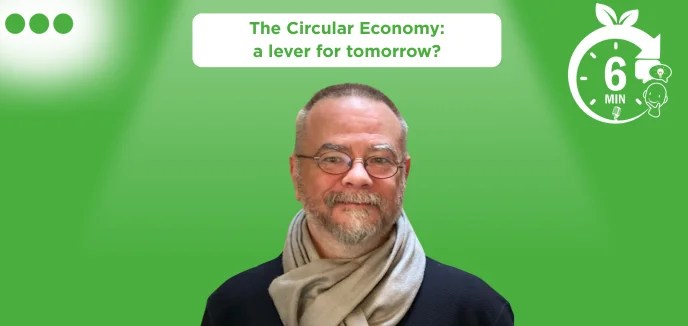
The Circular Economy, a Lever for Tomorrow? – “6 Min. to Understand” with Pierre Léonard. Midoricast: Podcast #220
You produce, you consume… then you throw away?
This is the pattern of the linear economy, still dominant today, but this model has reached its limits.
In this episode of “6 Minutes to Understand”, Pierre Léonard takes you into an alternative as powerful as it is necessary: the circular economy.
In focus:
- Reduction of waste
- Lower costs
- New business models
- Massive reduction in CO₂ emissions
With concrete examples, simple ideas to apply, and a challenge to take up, this episode turns a sometimes vague concept into a realistic action plan for all businesses.
A capsule to (re)listen to for thinking differently. Thanks to the KAYA coalition for the inspiration.
Listen to this podcast via Podcastics and subscribe, thank you!
To subscribe, choose your favorite app via the “See All” button in the list provided on our Linktree.
For people who are deaf, hard of hearing, or experiencing hearing difficulties, we provide a full transcript at the end of the article.
Make a donation to support our work: Triodos — IBAN : BE73 5230 8097 4160 — BIC : TRIOBEBB
Useful links for this episode:
- Pierre Léonard’s Linktree
- The Circular Economy Fresco
- Website of The Podcast Factory Org asbl-vzw
- Join the Kaya coalition
Links to support our association:
- Our Podcastics affiliate link (Note: valid for 7 days after opening the link)
- Our O2Switch affiliate link for top web hosting!
- Review our association The Podcast Factory Org asbl-vzw for its podcasts via our Google page
Our podcasts are accessible to everyone!
In addition to voicemail, each episode is sequenced and accompanied by a full transcript, allowing deaf and hard-of-hearing people to access it. And with a Google Translate plugin on Chrome, the episode becomes available in all languages! We also offer a video format and transcriptions as subtitles.
Why this section?
We support companies that implement real and measurable ESG (Environmental, Social, Governance) approaches. Pierre, for his part, trains and supports them towards this transition. Our approaches are different but complementary: we encourage, he supports.
This choice also raises a real challenge: where to draw the line?
Some companies mentioned in this section are not aligned with our current criteria, and we would refuse any collaboration with them as long as they do not initiate concrete change. But that is precisely where Pierre comes in: his role is to initiate this transformation.
This podcast does not seek to judge, but to inspire. The goal? Encourage rather than discourage, support rather than exclude.
Let’s commit together to a circular, sustainable and inclusive economy. Listening, reflection, action… in 6 minutes.
Listen to this podcast on the circular economy via our YouTube channel (subscribe: thank you!):
French: The full transcript of this podcast is offered as video subtitles in five languages: French, Dutch, German, English, and Spanish.
Dutch: De volledige transcriptie van deze podcast is beschikbaar als ondertiteling van de video in vijf talen: Frans, Nederlands, Duits, Engels en Spaans.
German: Die vollständige Transkription dieses Podcasts ist als Untertitel des Videos in fünf Sprachen verfügbar: Französisch, Niederländisch, Deutsch, Englisch und Spanisch.
English: The full transcript of this podcast is available as video subtitles in five languages: French, Dutch, German, English, and Spanish.
Spanish: La transcripción completa de este pódcast está disponible como subtítulos del vídeo en cinco idiomas: francés, neerlandés, alemán, inglés y español
Podcast sequencing on the circular economy:
- [00:00:34] Episode introduction
- [00:00:45] What is the linear economy?
- [00:00:56] How the linear model works
- [00:01:37] Obsolescence and end of life of objects
- [00:02:28] Definition of the circular economy
- [00:02:50] Why should companies be interested?
- [00:04:36] Where to start concretely?
- [00:05:25] Model: the product as a service
- [00:06:37] Collaborations and industrial symbiosis
- [00:07:10] Economic and ecological benefits
- [00:07:27] Challenge to listeners to take action
- [00:07:54] Invitation to join the KAYA coalition
- [00:08:10] Thanks and conclusion
Transcript of the podcast on the circular economy:
Michel: [00:00:00] This podcast project is an initiative created and proposed by the non-profit “The Podcast Factory Org”, with sponsorship from “transforma bxl – Innovation Playground”. Since January 2025, and for five years, we are also sponsored by “Plugin Company”, our preferred charging station and card operator. “The Podcast Factory Org” is very proud to be a member of “KAYA – Coalition of Ecopreneurs” and to collaborate with the “Love Health Center”. You can find all episodes of all our podcasts on the “What’s Your Story dot be” website.
Jingle Intro: [00:00:33] “You are listening to The Podcast Factory Org.”
Michel: [00:00:34] Welcome to a new episode of Midoricast, your podcast on positive environmental initiatives, and we meet Pierre Léonard for our “6 minutes to understand” segment, hello Pierre.
Pierre Léonard: [00:00:45] Hello Michel. Today, we’re going to talk about the linear economy and how we can transform this linear economy into a circular economy.
Pierre Léonard: [00:00:56] So what is the linear economy? Well, just imagine that our economy is a straight line going from point A to point B. At point A, we extract resources, then, in the process, we manufacture products, transport them, use them, and then, well, we throw them away, that’s point B. A very concrete example, to refer to a previous episode, is our mobile phones. Every year, we produce billions using precious resources, including those famous rare earths, but not only those. And after a few years of use, whether for tax depreciation reasons or because advertising has bewitched us, we replace them even though they still work perfectly well.
Michel: [00:01:37] Or because of planned obsolescence!
Pierre Léonard: [00:01:39] Or for reasons of planned obsolescence, which we’ll discuss in another episode. After a few years of use, most of these smartphones end up, in the worst case, in landfills, in the best case, recycled, but often poorly or insufficiently recycled. And anyway, we waste a lot of rare metals because, for reasons I won’t explain here, it’s impossible to recycle all the metals that are notably in phones. And there you have it, that’s the picture of the linear economy. And it’s a model that has dominated since the industrial revolution when we thought our small finite planet had infinite resources. And even today, this linear model accounts for more than 9/10 of our total economy. Obviously, you’ve understood, it has a major problem: it’s not at all sustainable, not in the long term, nor even now in the medium term.
Pierre Léonard: [00:02:28] That’s where the circular economy comes in. Instead of a straight line, now imagine a circle. In this model, we make sure to use resources a first time, certainly, but also to reuse and recycle them again and again, as much as possible. Waste becomes a new resource and we have a closed loop, at least as closed as possible.
Pierre Léonard: [00:02:50] But why, you ask, should companies be interested? Well, the circular economy has many significant advantages. First, it offers enormous economic potential. According to the World Economic Forum, the circular economy could generate by 2030 savings greater than Germany’s GDP. Second, it allows for considerable cost reduction. Imagine, you know we’re depleting our resources, there are X years of copper left, X years of coal, X years of oil… what does that mean? Simply with the law of supply and demand, the prices of these raw materials are bound to rise, inexorably. If you, as a company, can reduce your needs for these raw materials, you will automatically save money. You will also make your supply chain more resilient because you’ll be less dependent on your suppliers and those resources. And you may even have the opportunity to become a reseller of these raw materials on markets that already exist. But that’s not all: the circular economy stimulates innovation, especially with eco-design. How can I make my product more circular? With eco-design, it pushes companies to rethink their products and processes, opening the way to new business models and technological advances. I mentioned resilience, I won’t go back to it, we have fewer and fewer virgin resources, so being able to detach from them to some extent is all beneficial. And finally, it’s crucial. The circular economy is a very powerful tool to fight climate change. Experts estimate that by doubling the global circularity rate, i.e., bringing it to about 20%, we could reduce our global greenhouse gas emissions by nearly 40%.
Pierre Léonard: [00:04:36] How can companies start integrating all these circular economy principles? If you haven’t already, know that we could devote several episodes to this, but here are two ideas. First, start by rethinking your products: how can I make, for example, a pencil, a simple pencil, is it durable? No, it’s not durable because it gets used up as you go. First, there are raw materials from all over the world: graphite from the mine, wood, paint around the wood, rubber, etc. And this pencil is not at all durable. So how can we make it circular? I won’t give you the answer, I invite you to give it to me, either by email or by leaving me a little message, and maybe we’ll talk about it next time. Making products more circular is already a possibility. So, in summary, rethink your products so that they last longer, use fewer raw materials, generate less CO2, and produce less waste.
Pierre Léonard: [00:05:25] Second possibility: explore new business models. There’s a model called product-as-a-service. We also talk about the functional economy where, instead of paying to own an object, you simply pay to use it. The simplest example I can give is a book, quite simply. Imagine you go to a bookstore to buy a book, you will own this book, it will be on your shelf, you can read it, take it whenever you want, but you’ll be the only one to use it. On the other hand, if instead of buying it, you borrow it from a public library, you’ll also have access to this book, you can read it as many times as you want, but its use will be shared among maybe 50 people. Which means its carbon footprint will be divided by 50. And that also means the 49 trees, I’m simplifying, that would have been needed to make 49 other books, well, they’ll remain standing in the forest. This model—renting rather than owning—is a very powerful lever to reduce, to circularize consumption habits. And it’s also a business model that can be very, very profitable. I’ll mention some examples next time.
Pierre Léonard: [00:06:37] And finally, collaborate: the circular economy is about synergies, collaborations, clusters, symbioses. For example, one can easily imagine—and it exists—a steel company selling its residual heat to a city, to a municipal administration, to a town hall, so that this town hall heats its public buildings. That’s an example of what’s called industrial symbiosis. There are plenty of other levers in the circular economy, which is a truly fascinating field to explore. I think we’ll come back to it in other episodes.
Pierre Léonard: [00:07:10] But above all, remember that the transition to a circular economy, even if it’s not without challenges, has very, very clear advantages. It offers a path to sustainable economic growth, sustainable development, better business resilience, and reduced environmental impact.
Pierre Léonard: [00:07:27] So I challenge you to conclude: where can you start to integrate the principles of the circular economy into your business today? The answer doesn’t have to be complicated, nor difficult to implement; start by looking at your everyday objects and see how you can answer this question, because it could very well define the success of your business in the years to come. Thank you for following me during these “6 minutes to understand” the circular economy, and I’ll see you in two weeks for the next episode.
Michel: [00:07:54] If you allow me, Pierre, I’d like to add a little add-on to this capsule. I’d also like to say that a first step that can be taken is to join the KAYA coalition—Coalition of Ecopreneurs, of which we are both members and proud to be. A little nod to say hats off and thanks to them.
Pierre Léonard: [00:08:10] And thank you for mentioning it.
Michel: [00:08:11] See you soon.
Jingle Outro: [00:08:16] “You are listening to The Podcast Factory Org.”
Michel: [00:08:17] This podcast project is an initiative created and proposed by the non-profit “The Podcast Factory Org”, with sponsorship from “transforma bxl – Innovation Playground”. Since January 2025, and for five years, we are also sponsored by “Plugin Company”, our preferred charging station and card operator. “The Podcast Factory Org” is very proud to be a member of “KAYA – Coalition of Ecopreneurs” and to collaborate with the “Love Health Center”. You can find all episodes of all our podcasts on the “What’s Your Story dot be” website.
All our Midoricast podcasts

Podcast: Play in new window | Download
#PodiBUZ, the editorial brand of The Podcast Factory Org ASBL-VZW.


